
George Miloshevich
Assistant Professor (European Research Fellow) · Solar and Space Physics
Department of Mathematics, Physics and Electrical Engineering · Northumbria University
My research focuses on understanding and predicting complex plasma processes in turbulent environments such as space plasmas, combining theory, simulations, data-driven methods — from modelling turbulent plasmas to predicting extreme events. I serve as an Associate Editor of JGR: Machine Learning and Computation and I am project manager of ASAP, which develops AI for space missions — neural networks and the software/hardware to run them onboard, so that spacecraft can analyse and compress their observations in orbit instead of downlinking everything to Earth.
Research Grants held
STRIDE
Marie Skłodowska-Curie Fellowship
Neural-network and symbolic-regression closures for particle effects in plasma fluid and hybrid models.
D-SURGE
ERC Starting Grant · PI
Data-driven simulations of reconnection and geomagnetism, bridging particle dynamics and the global magnetosphere.
Helioskill
FWO Project · co-PI
Data-driven equation of state of the solar wind from in-situ data and particle-in-cell simulations.
research interests
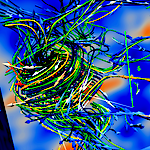
- Turbulence and reconnection in solar wind and magnetospheric plasmas — cascades and coherent structures in kinetic Alfvén-wave turbulence, energy channels and pressure–strain interaction in magnetosheath turbulence, studied with hybrid and implicit fully kinetic Particle-in-Cell codes as well as extended-MHD theory and gyrofluid simulations
- Data-driven plasma modelling — building kinetic corrections to fluid models: neural-network, analytic, and symbolic-regression closures learned from fully kinetic simulations, and equations of state for reduced-order modelling
- Space weather — Coronal Mass Ejection (CME) forecasting, solar flare classification and automated detection of coronal structures
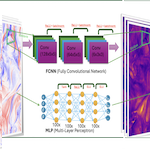
- Onboard algorithms for space missions — neural networks running on FPGAs that detect solar structures, compress data, and ease downlink bottlenecks on resource-limited spacecraft to provide more science per bit of telemetry in future space missions
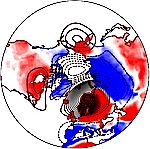
- Extreme events in environmental science — forecasting long-lasting European heatwaves weeks ahead with convolutional networks and stochastic weather generators, and estimating return times of unprecedented events with rare-event algorithms and extreme value statistics
- Hamiltonian methods — structure-preserving closures and reductions of extended MHD and Vlasov–Maxwell
More on these topics can be found in my publications, talks, and projects.
My PhD from the University of Texas at Austin focused on Hamiltonian descriptions of microscopic kinetic effects in turbulent collisionless plasmas, combining analytical theory and numerical simulation. Before returning to plasma physics, I spent several years in environmental data science, developing data-driven forecasts of extreme European heatwaves at ENS de Lyon and CEA Saclay.
Originally I come from a small country, nestled in Caucasus. Growing up in a diverse family, I have always enjoyed and appreciated multicultural settings.
news
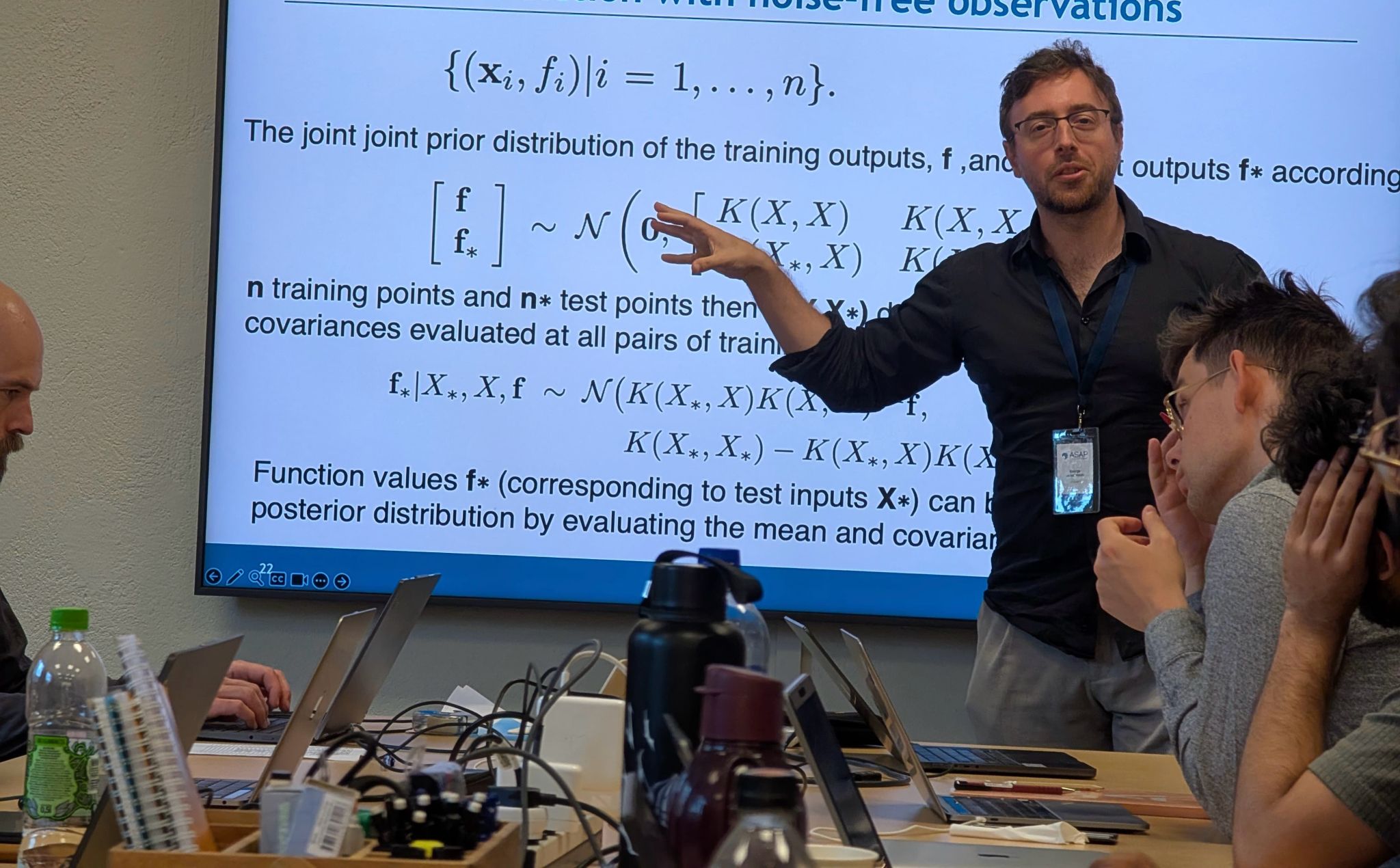
I will be teaching at the ASAP Summer School on Machine Learning for Space 2026, which will take place 8-12 June 2026...
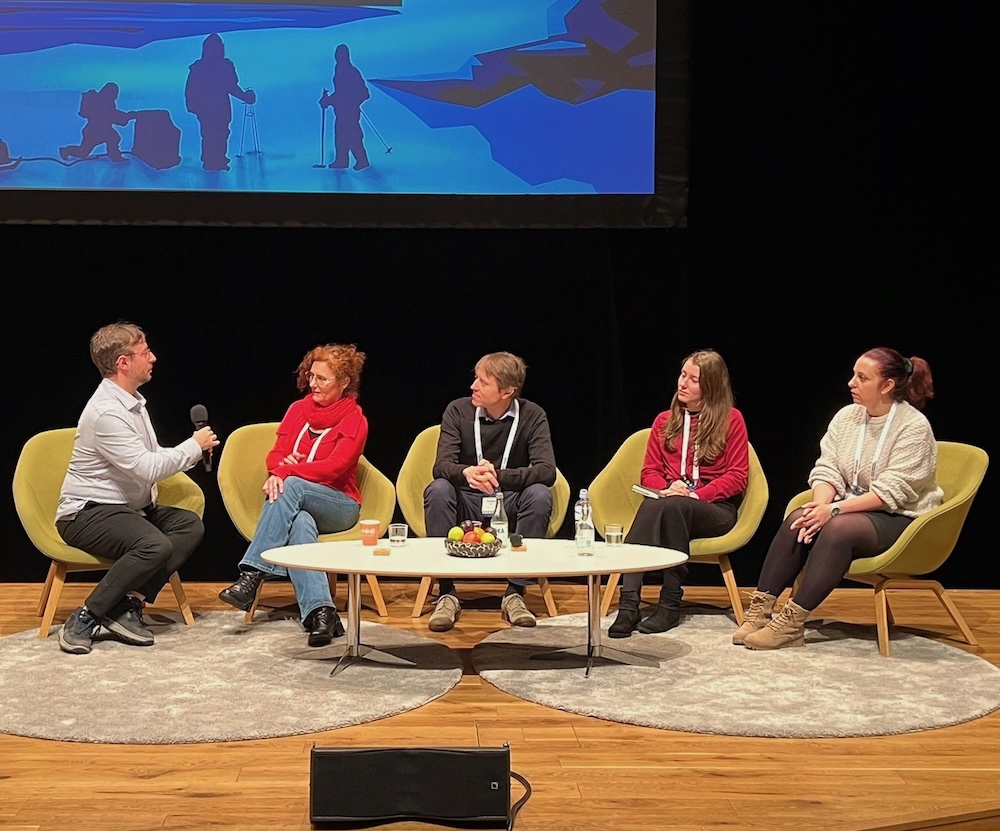
Topical discussion meeting at ESWW held, details in the blog post.
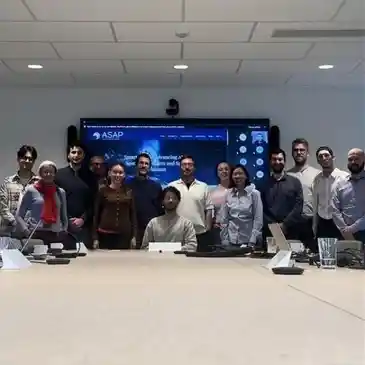
Workshop at KU Leuven for on-board AI applications, October 7: details and RSVP ->.

ERC Starting Grant Awarded: D-SURGE ProjectI have been awarded a European Research Council (ERC) Starting Grant for m...
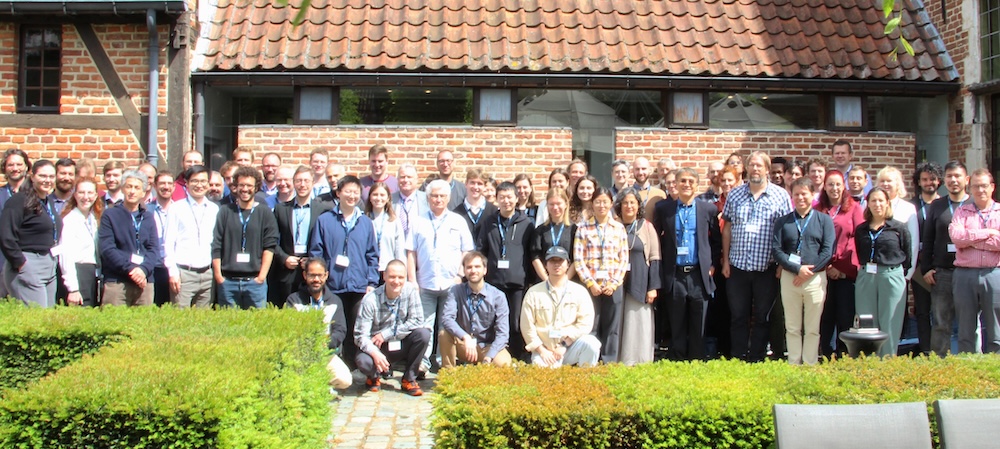
We are organizing a memorial workshop in memory of Giovanni Lapenta at KU Leuven details and RSVP ->.
latest posts
“What is needed is Validation, validation, validation.” - Jasmina Magdalenic, during the meeting.Topical Discussion...
NOTE:Guide for using python wrapper for WHAMP (Waves in Homogeneous Anisotropic Magnetized Plasma). The example that ...
Working in climate science has been an interesting journey. It is a field that is extraordinary in that communication...